Showing posts with label composition. Show all posts

Tuesday, 5 February 2013

Mathematism, part the First


And so it begins, my inevitable descent into uncontrollable OCD. I want to get this model as accurate as possible, so with a red pencil, a near-dead iPod as a calculator, and a pink tape measure more suited to the fashion lot upstairs, I set out to calculate as many of the values in this piece as possible. As you can see, I didn't get anywhere close.

However, I did make two critical discoveries; first, this etching actually has a vanishing point. The horizon is about 50 feet below the shot. Second, Piranesi is not using the 70 degree field of view of a human eye here; the camera angle is about 135 degrees. No wonder the perspective looks weird. Given the time these etchings were made (1760-ish) and the amount of knowledge about perspective that was available then, I suspect Piranesi's camera angle was a (mercifully consistent) mistake, rather than an artistic choice. It also explains why I was having such trouble reproducing the shot in Maya.

This will be continually updated overthe next few days as I nail down all the measurements. Watch this space for an exercise in dullness and pedantry.

Friday, 1 February 2013

Attempting to Comprehend the Carcere. Send Help.

More work on the pre-viz, with a bit of improvising for the background forms. Still nowhere near finished.

Where does that pillar/wall/thing with poles sticking out go? Further back, where it meets the bar coming off the far wall but doesn't pass the bottom of the shot like it does in the original?

Is it closer to the camera?

But then what about the far wall? The strut coming out of the side connects to the two struts coming out from the pillar nearest camera! The far wall can't come forward or it disconnects from the central pavilion thing.

Does it descend lower than the camera to give the illusion of being closer? Where the hell is the floor, anyway? And how does this camera work?

I am beginning to understand why Piranesi could never get a job in architecture.

Monday, 14 January 2013

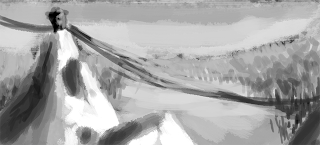
Mostly-Blind Study of 'Shipwreck in a Rocky Inlet' - Carlo Bonavia

Did something a little different today. In the vein of the Technical Challenge in the Great British Bake-Off, where the contestants are required to use their baking knowledge and instinct to replicate a bare-bones recipe, I decided to make a very quick study from a painting - in this case, Carlo Bonavia's 'Shipwreck in a Rocky Inlet'. From there I no longer looked at the original, instead relying on my early sketch and my painting knowse to highlight what I did and didn't know.

Shipwreck in a Rocky Inlet - Carlo Bonavia, 1757

My initial sketch, the only part of the painting that actually referenced the original. Observe the absenve of the ship - this continues the whole way through, because I was more interested in the overall landscape than the fiddly details of the ship.

 
Attempting to come to terms with that rock.

Ehhh... let's add 'rock' to the list of things I need to study.

Let's throw 'clouds' onto that list, too.

And my final, with distinctly absent shipwreck and a lighthouse that was definitely not there in the original. It needed something to be sitting there, and that whole side was dark, so a lighthouse seemed the obvious choice. Oh, and just for good measure, put 'water' on the list as well.

And here's the original again, for comparison's sake. Goddamn, did I lose track of it. Nevertheless, despite not having a technically brilliant outcome, I learnt a lot about what I don't know, which in some cases is far more important than actually learning something objectively useful.

Friday, 30 November 2012

Photoshop Speedpaints


Photoshop Phil had us working at ludicrous speed today - 15 minutes on each set of three sketches, or 5 minutes/sketch. It was pretty fun, and you can see my work loosen up with each sketch.


We then grabbed our favourite of the panels and worked into it for ten more minutes; amazing the difference a deadline makes! Phil showed me how to make crisp snow shadows with the lasso tool, which not only sped me up but immensely improved the final outcome.

Tuesday, 13 November 2012

Figuring It Out


Two more concept painting sketches. These two were disproportionately difficult and time-consuming (you can see where I got bored and frustrated), and after I gave up on them I worked out why. Neither of the two paintings looked like the space I wanted them to be, because I already had figured out and put down that space; I just didn't realise it.


Obviously it will take some tweaking and refinement, but at the very least I now know what I'm doing.

Friday, 9 November 2012

Initial Colour Thoughts


Starting to think about colour. None of these feel particularly 'right' to me; perhaps it's just the low level of finish, but I have no doubt it's also my innate struggle with surface colour and making them work together in realistic lighting.

Clockwork Soldier Thumbnails, Part the Third


Even more thumbs. I'm leaning towards an old, venerable atlas for the soldier's hero prop - it's big and I can make it distinctive against all the 'filler' books, and encapsulates how he misses the outside world. Beyond that just some more fiddling with cell shapes, general clutter and shot angles. Practically speaking I prefer the angle in #28 - it shows everything off nicely and gives a good sense of the size of the space. Purely as an artist I like the angle in #30, as it really emphasises the soldier's clockwork nature and puts the focus onto the workbench. Unfortunately, such a low angle means you can barely see anything else.

Friday, 2 November 2012

Clockwork Soldier Initial Thoughts and Thumbnails


Upon talking to Phil, I've reached the conclusion that this clockwork soldier is a weapon of war, a 'person of mass destruction'. I'm alternating between it being purely a clockwork automaton that has somehow developed sentience and a human brain (or part of one) piloting a clockwork body. Either way, the clockwork soldier has become outmoded and is no longer an effective weapon, so his creators want rid of him. Unfortunately, he is very well-made; so well-made, in fact, as to be completely tamper-proof, so deconstructing him is out of the question, and simply setting him free is too risky given his weaponised nature. As a result, he has been locked away and forgotten in some vault or bunker somewhere, to wait for the day he finally stops.

Phil and I discussed the possibility of the soldier being a reluctant warrior, not wanting to harm anyone but, being what he is, having no other choice. I imagine him as quite a gentle soul, not naturally aggressive but with a truly impressive in-built arsenal that makes him a danger to be near. Locked away in his vault he tries to hang on to the human soul he either has or developed, surrounding himself with personal treasures and trying to make the dead, empty vault into a home. Despite being completely alone and isolated he still tries to live as well as he can.


A not-so-quick concept painting where I just noodled with  design and tried to force myself to design in perspective and on the fly, something I really struggle with (check out all the isometric drawings in the thumbnails for proof of this). Not fond of the actual rendering, but design and perspective-wise I'm not unhappy at all.


And, just to finish, a super-quick study of Al Capone's prison cell, to get a feel for a 'home-y' prison.

Monday, 15 October 2012

Photoshop Exercises 2


And part two, the more refined stuff. #1 was originally just an attempt to get out an idea that's been chasing me for years and has never quite come out properly that accidentally became an exercise in three-point perspective. #2 was just noodling with colour and composition, while #3 appears to be me channelling myself this time last year when I did 20,000 Leagues Under the Sea. What it's actually supposed to be I don't even know any more.

Photoshop Exercises 1


Aaaand this is part one of two of what I've been up to in Photoshop Phil's classes. First four are quick thumbnails to get a feel for composition, last two are (rather obviously) perspective exercises. #2 feels like it could go somewhere, if I zoomed it out and threw in some curvature to the bridge, as well as define the three 'layers' of the painting more. #3 was a (possibly ill-advised) attempt at replicating a fisheye lens. Not sure if it worked, but it was interesting if nothing else.